Papers by Joost van de Weijer
Social Science Research Network, 2022
Computer vision has established a foothold in the online fashion retail industry. Main product de... more Computer vision has established a foothold in the online fashion retail industry. Main product detection is a crucial step of vision-based fashion product feed parsing pipelines, focused on identifying the bounding boxes that contain the product being sold in the gallery of images of the product page. The current state-of-the-art approach does not leverage the relations between regions in the image, and treats images of the same product independently, therefore not fully exploiting visual and product contextual information. In this paper, we propose a model that incorporates Graph Convolutional Networks (GCN) that jointly represent all detected bounding boxes in the gallery as nodes. We show that the proposed method is better than the state-of-the-art, especially, when we consider the scenario where titleinput is missing at inference time and for cross-dataset evaluation, our method outperforms previous approaches by a large margin. Arnau Ramisa's work was done prior to joining Amazon.
New Results - Image descriptors and correspondence
IEEE Signal Processing Letters, Jun 1, 2019
In this paper, we adapt the geodesic distance-based recursive filter to the sparse data interpola... more In this paper, we adapt the geodesic distance-based recursive filter to the sparse data interpolation problem. The proposed technique is general and can be easily applied to any kind of sparse data. We demonstrate the superiority over other interpolation techniques in three experiments for qualitative and quantitative evaluation. In addition, we compare our method with the popular interpolation algorithm presented in the EpicFlow optical flow paper that is intuitively motivated by a similar geodesic distance principle. The comparison shows that our algorithm is more accurate and considerably faster than the EpicFlow interpolation technique.
This paper addresses the problem of inferring unseen cross-domain and cross-modal image-toimage t... more This paper addresses the problem of inferring unseen cross-domain and cross-modal image-toimage translations between multiple domains and modalities. We assume that only some of the pairwise translations have been seen (i.e. trained) and infer the remaining unseen translations (where training pairs are not available). We propose mix and match networks, an approach where multiple encoders and decoders are aligned in such a way that the desired translation can be obtained by simply cascading the source encoder and the target decoder, even when they have not interacted during the training stage (i.e. unseen). The main challenge lies in the alignment of the latent representations at the bottlenecks of encoder-decoder pairs. We propose an architecture with several tools to encourage alignment, including autoencoders and robust side information and latent consistency losses. We show the benefits of our approach in terms of effectiveness and scalability compared with other pairwise image-to-image translation approaches. We also propose zero-pair cross-modal image translation, a challenging setting where the objective is inferring semantic segmentation from depth (and vice-versa) without explicit segmentation-depth pairs, and only from two (disjoint) segmentation-RGB and depth-segmentation training sets. We observe that certain part of the shared information between unseen domains might not be reachable, so we further propose a variant that leverages pseudo-pairs to exploit all shared information.
Advances in intelligent systems and computing, 2018
There exists a significant amount of research on color naming of single colored objects. However ... more There exists a significant amount of research on color naming of single colored objects. However in reality many fashion objects consist of multiple colors. Currently, searching in fashion datasets for multicolored objects can be a laborious task. Therefore, in this paper we focus on color naming for images with multi-color fashion items. We collect a dataset, which consists of images which may have from one up to four colors. We annotate the images with the 11 basic colors of the English language. We experiment with several designs for deep neural networks with different losses. We show that explicitly estimating the number of colors in the fashion item leads to improved results.
arXiv (Cornell University), Jan 23, 2020
In this paper, we propose an approach without any forgetting to continual learning for the task-a... more In this paper, we propose an approach without any forgetting to continual learning for the task-aware regime, where at inference the task-label is known. By using ternary masks we can upgrade a model to new tasks, reusing knowledge from previous tasks while not forgetting anything about them. Using masks prevents both catastrophic forgetting and backward transfer. We argue -and show experimentally -that avoiding the former largely compensates for the lack of the latter, which is rarely observed in practice. In contrast to earlier works, our masks are applied to the features (activations) of each layer instead of the weights. This considerably reduces the number of mask parameters to be added for each new task; with more than three orders of magnitude for most networks. The encoding of the ternary masks into two bits per feature creates very little overhead to the network, avoiding scalability issues. Our masks do not permit any changes to features which are used by previous tasks. As this may be too restrictive to allow learning of new tasks, we add task-specific feature normalization. This way, already learned features can adapt to the current task without changing the behavior of these features for previous tasks. Extensive experiments on several finegrained datasets and ImageNet show that our method outperforms current state-of-the-art while reducing memory overhead in comparison to weight-based approaches.

Color in Computer Vision: Fundamentals and Applications
While the field of computer vision drives many of todays digital technologies and communication n... more While the field of computer vision drives many of todays digital technologies and communication networks, the topic of color has emerged only recently in most computer vision applications. One of the most extensive works to date on color in computer vision, this book provides a complete set of tools for working with color in the field of image understanding.Based on the authors intense collaboration for more than a decade and drawing on the latest thinking in the field of computer science, the book integrates topics from color science and computer vision, clearly linking theories, techniques, machine learning, and applications. The fundamental basics, sample applications, and downloadable versions of the software and data sets are also included. Clear, thorough, and practical, Color in Computer Vision explains:Computer vision, including color-driven algorithms and quantitative results of various state-of-the-art methodsColor science topics such as color systems, color reflection mechanisms, color invariance, and color constancyDigital image processing, including edge detection, feature extraction, image segmentation, and image transformationsSignal processing techniques for the development of both image processing and machine learningRobotics and artificial intelligence, including such topics as supervised learning and classifiers for object and scene categorization Researchers and professionals in computer science, computer vision, color science, electrical engineering, and signal processing will learn how to implement color in computer vision applications and gain insight into future developments in this dynamic and expanding field.
arXiv (Cornell University), Oct 23, 2020
Unsupervised domain adaptation (UDA) aims to transfer the knowledge learned from labeled source d... more Unsupervised domain adaptation (UDA) aims to transfer the knowledge learned from labeled source domain to unlabeled target domain. Existing UDA methods require access to the data from the source domain, during adaptation to the target domain, which may not be feasible in some real-world situations. In this paper, we address Source-free Unsupervised Domain Adaptation (SFUDA), where the model has no access to any source data during the adaptation period. We propose a novel framework named BAIT to tackle SFUDA. Specifically, we first train the model on source domain. With the source-specific classifier head (referred to as anchor classifier) fixed, we further introduce a new learnable classifier head (referred to as bait classifier), which is initialized by the anchor classifier. When adapting the source model to the target domain, the source data are no more accessible and the bait classifier aims to push the target features towards the right side of the decision boundary of the anchor classifier, thus achieving the feature alignment. Experiment results show that proposed BAIT achieves state-of-the-art performance compared with existing normal UDA methods and several SFUDA methods.
IEEE transactions on image processing, Dec 1, 2015
The property of smoothing while preserving edges makes the bilateral filter a very popular image ... more The property of smoothing while preserving edges makes the bilateral filter a very popular image processing tool. However, its non-linear nature results in a computationally costly operation. Various works propose fast approximations to the bilateral filter. However, the majority does not generalize to vector input as is the case with color images. We propose a fast approximation to the bilateral filter for color images. The filter is based on two ideas. Firstly, the number of colors which occur in a single natural image is limited. We exploit this color sparseness to rewrite the initial non-linear bilateral filter as a number of linear filter operations. Secondly, we impose a statistical prior to the image values which are locally present within the filter window. We show that this statistical prior leads to a closedform solution of the bilateral filter. Finally, we combine both ideas into a single fast and accurate bilateral filter for color images. Experimental results show that our bilateral filter based on the local prior yields an extremely fast bilateral filter approximation, but with limited accuracy, which has potential application in realtime video filtering. Our bilateral filter which combines color sparseness and local statistics yields a fast and accurate bilateral filter approximation and obtains state-of-the-art results.
arXiv (Cornell University), Mar 14, 2023
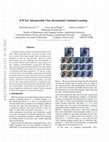
Continual learning enables incremental learning of new tasks without forgetting those previously ... more Continual learning enables incremental learning of new tasks without forgetting those previously learned, resulting in positive knowledge transfer that can enhance performance on both new and old tasks. However, continual learning poses new challenges for interpretability, as the rationale behind model predictions may change over time, leading to interpretability concept drift. We address this problem by proposing Interpretable Class-InCremental LEarning (ICICLE), an exemplar-free approach that adopts a prototypical part-based approach. It consists of three crucial novelties: interpretability regularization that distills previously learned concepts while preserving user-friendly positive reasoning; proximity-based prototype initialization strategy dedicated to the fine-grained setting; and taskrecency bias compensation devoted to prototypical parts. Our experimental results demonstrate that ICICLE reduces the interpretability concept drift and outperforms the existing exemplar-free methods of common class-incremental learning when applied to concept-based models.
Area Under the ROC Curve Maximization for Metric Learning
2022 IEEE/CVF Conference on Computer Vision and Pattern Recognition Workshops (CVPRW), Jun 1, 2022
arXiv (Cornell University), Mar 28, 2023
Distributed learning on the edge often comprises self-centered devices (SCD) which learn local ta... more Distributed learning on the edge often comprises self-centered devices (SCD) which learn local tasks independently and are unwilling to contribute to the performance of other SDCs. How do we achieve forward transfer at zero cost for the single SCDs? We formalize this problem as a Distributed Continual Learning scenario, where SCD adapt to local tasks and a CL model consolidates the knowledge from the resulting stream of models without looking at the SCD's private data. Unfortunately, current CL methods are not directly applicable to this scenario. We propose Data-Agnostic Consolidation (DAC), a novel double knowledge distillation method that consolidates the stream of SC models without using the original data. DAC performs distillation in the latent space via a novel Projected Latent Distillation loss. Experimental results show that DAC enables forward transfer between SCDs and reaches stateof-the-art accuracy on Split CIFAR100, CORe50 and Split TinyImageNet, both in reharsal-free and distributed CL scenarios. Somewhat surprisingly, even a single out-of-distribution image is sufficient as the only source of data during consolidation.
Improved Recursive Geodesic Distance Computation for Edge Preserving Filter
IEEE transactions on image processing, Aug 1, 2017
All known recursive filters based on the geodesic distance affinity are realized by two 1D recurs... more All known recursive filters based on the geodesic distance affinity are realized by two 1D recursions applied in two orthogonal directions of the image plane. The 2D extension of the filter is not valid and has theoretically drawbacks, which lead to known artifacts. In this paper, a maximum influence propagation method is proposed to approximate the 2D extension for the geodesic distance-based recursive filter. The method allows to partially overcome the drawbacks of the 1D recursion approach. We show that our improved recursion better approximates the true geodesic distance filter, and the application of this improved filter for image denoising outperforms the existing recursive implementation of the geodesic distance. As an application, we consider a geodesic distance-based filter for image denoising. Experimental evaluation of our denoising method demonstrates comparable and for several test images better results, than state-of-the-art approaches, while our algorithm is considerably faster with computational complexity O(8P).
arXiv (Cornell University), Feb 1, 2023
The current dominant paradigm when building a machine learning model is to iterate over a dataset... more The current dominant paradigm when building a machine learning model is to iterate over a dataset over and over until convergence. Such an approach is non-incremental, as it assumes access to all images of all categories at once. However, for many applications, non-incremental learning is unrealistic. To that end, researchers study incremental learning, where a learner is required to adapt to an incoming stream of data with a varying distribution while preventing forgetting of past knowledge. Significant progress has been made, however, the vast majority of works focus on the fully supervised setting, making these algorithms label-hungry thus limiting their real-life deployment. To that end, in this paper, we make the first attempt to survey recently growing interest in label-efficient incremental learning. We identify three subdivisions, namely semi-, few-shotand self-supervised learning to reduce labeling efforts. Finally, we identify novel directions that can further enhance label-efficiency and improve incremental learning scalability. Project website: .
Density Map Distillation for Incremental Object Counting
arXiv (Cornell University), Jun 29, 2023
Neural networks are very effective when trained on large datasets for a large number of iteration... more Neural networks are very effective when trained on large datasets for a large number of iterations. However, when they are trained on non-stationary streams of data and in an online fashion, their performance is reduced (1) by the online setup, which limits the availability of data, (2) due to catastrophic forgetting because of the non-stationary nature of the data. Furthermore, several recent works showed that replay methods used in continual learning suffer from the stability gap, encountered when evaluating the model continually (rather than only on task boundaries). In this article, we study the effect of model ensembling as a way to improve performance and stability in online continual learning. We notice that naively ensembling models coming from a variety of training tasks increases the performance in online continual learning considerably. Starting from this observation, and drawing inspirations from semi-supervised learning ensembling methods, we use a lightweight temporal ensemble that computes the exponential moving average of the weights (EMA) at test time, and show that it can drastically increase the performance and stability when used in combination with several methods from the literature.
Color Image Formation
Color in Computer Vision, 2012



Uploads
Papers by Joost van de Weijer